
The Male Body at Climax: What Have We Never Been Taught?
Updated: 5 days ago
Let Me Start With A Very Simple Question?
Who taught you how to masturbate?
Probably nobody.
I've been asking my trusted clients this question recently, and it usually gets a laugh.
Because once you think about it, it's strange.
Most of us received some basic sex education.
We learned about erections early in life, usually by surprise, and then the less fun parts of sexual lie: sperm count, contraception, sexually transmitted infections and reproduction. But nobody actually sat us down and explained what happens to the male body during orgasm.

Why am I interested in that?
Well, because like me, you probably just learned as you went along.
And maybe there is more to it.
Most men simply discovered masturbation along the way and figured out the rest.
There is no academy where you graduate with a Master's in Masturbation.
So maybe you found something that worked and you stuck to it.
Your nervous system learned the route too.
And you probably repeated essentially the same muscular pattern thousands of times.
Why challenge the establishment if it works? Not all the time, perhaps, but well… nobody is perfect.
Nobody asked what your knees were doing.
Nobody asked what happened to your breathing.
Nobody asked whether your toes were gripping.
Nobody asked whether your pelvis was free to move.
Nobody asked whether you were experiencing your orgasm or simply getting yourself to ejaculation.
And perhaps those are questions worth asking.
Orgasm and ejaculation aren't actually the same thing.
This distinction is important.
Ejaculation is a coordinated physiological process involving the nervous system, reproductive structures and muscles of the pelvis. It has two principal phases: emission and expulsion.
During expulsion, muscles including the bulbospongiosus, ischiocavernosus and other pelvic-floor muscles contract rhythmically to propel semen through the urethra.
Interestingly, studies describe these contractions occurring at intervals of roughly 0.8 seconds during the initial phase of ejaculation.
Orgasm, however, is the subjective experience of sexual climax.
Usually orgasm and ejaculation happen together, which is probably why we speak about them as though they are one event. Physiologically, however, they can be separated.
Orgasm can occur without ejaculation, and ejaculation can occur with altered or diminished orgasmic sensation.
Despite everything we know about human sexuality, researchers still acknowledge that much remains unknown about the physiology of male orgasm.
So perhaps there is more room for curiosity here than we realise.
Something I’ve noticed over the years in my work is.
When I'm working around the hips, glutes and structures associated with pelvic tension, a certain pattern repeats.

A very tight piriformis.
Restriction around the sacrum and coccyx.
Hips that don't move easily.
Knees habitually held straight or locked.
Legs that seem permanently prepared for effort.
Sometimes even the feet tell the same story: instead of the toes being relaxed, mobile and spread, they grip almost like a claw.
These are clinical observations from my own bodywork practice, not a diagnostic rule.
There are many reasons somebody might develop any of these patterns. But the repetition made me curious.
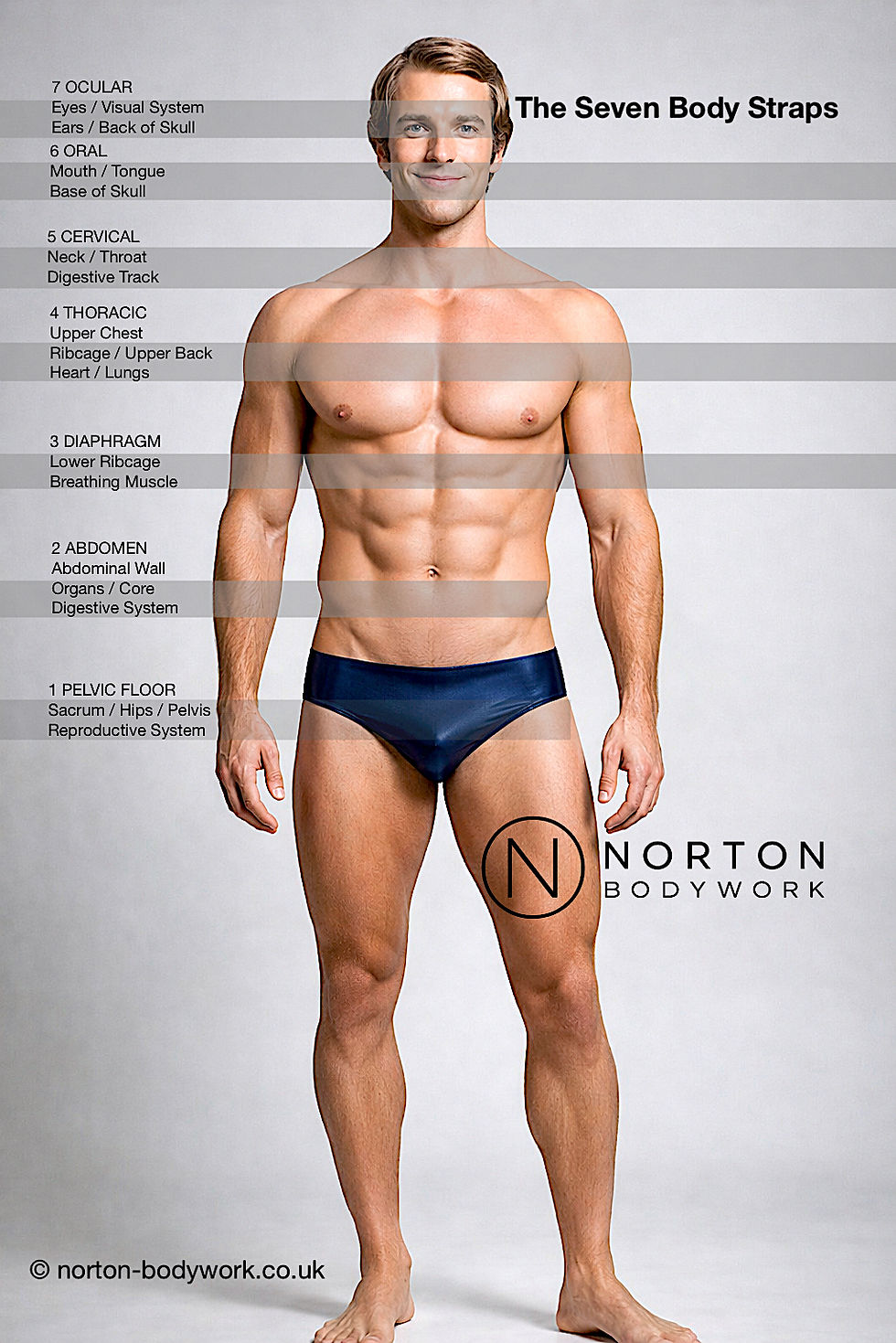
Because the pelvic floor doesn't live by itself. It participates in a larger muscular system involving the hips, abdomen, diaphragm, spine and legs.
And hypertonic pelvic-floor conditions in men are recognised clinically.
Chronic stress and anxiety, prolonged sitting, habitual buttock gripping, poor coordination and overactivation of muscles around the hips and pelvis are among the factors associated with increased pelvic-floor tension.
For somebody sitting at a desk for ten hours and then training hard in the gym, this shouldn't be particularly surprising.
The body gets very good at holding.
Then I started asking another question:
What happens to your legs when you ejaculate?
Do you tighten them?
Do you straighten them?
Do you lock your knees?
Do you clench your buttocks?
Do your toes curl?
Do you hold your breath?
What surprised me wasn't simply the answers.
It was how few men had ever thought about the question.
Many recognised the same pattern immediately: as orgasm approaches, they increase muscular effort.
The legs become rigid.
The glutes tighten.
The abdomen braces.
The pelvis becomes controlled.
The entire body participates in getting them over the line. Almost like running a 100-metre race.
And that's when another question appeared for me:
Where did we learn to do that?
Most men learned through experimentation. Perhaps through masturbation as teenagers.
Later through partners. And inevitably, for many generations of men, through copying what we see in porn.
Once something successfully produces orgasm, the nervous system has a very good reason to remember it.
Repeat the same position, pressure, speed, muscular contraction and breathing pattern enough times and it becomes familiar. Eventually you aren't consciously deciding to tighten your legs.
They just do it for you on autopilot.
But a learned pattern isn't necessarily the only pattern available to the body.
And that distinction interests me enormously.
I'm not suggesting there is a correct way to masturbate or a correct way to ejaculate.
The last thing men need is another performance standard.
I'm asking something much simpler:
Have you ever noticed what your body is actually doing?
Performance enters the bedroom.
Male sexuality carries an extraordinary amount of performance.
Am I hard enough?
Am I big enough?
Will I last long enough?
Can I satisfy my partner?
Do I look masculine?
Can I control when I come?
Modern sexual-medicine literature recognises sexual performance anxiety as a genuine factor capable of interfering with sexual response.
And there's an interesting contradiction here.
Erection, ejaculation and orgasm involve major autonomic and reflex components.
They aren't simply actions that can be commanded through willpower.
Yet culturally we often approach male sexuality as though the man should be completely in command of the machinery.
Control it.
Hold it.
Delay it.
Perform.
Deliver.
“I'm going to give it to you.”
We've all heard versions of that masculine script that have conditioned our experiences.
There's nothing inherently wrong with intensity or vigorous sex.
But what happens when performance becomes the only language the body knows?
And then there is the penis.
Male sexual self-esteem can become attached to:
Size.
Shape.
Erection quality.
Duration.
Comparison.
Whether a partner approves of it.
Whether somebody might laugh at it.
Whether it looks like the bodies we have seen in "that movie".
Research into male sexual dysfunction consistently encounters shame, diminished sexual confidence, body-image concerns and reduced self-esteem.
Even research involving female partners shows that male ejaculation itself can become part of how sexual satisfaction is evaluated.
One study of 240 heterosexual women found that about half considered their partner ejaculating during intercourse very important.
So the man isn't necessarily only experiencing his body.
He may also be watching himself being evaluated.
And the more attention moves towards performance, perhaps the less attention remains for sensation. We have become remarkably sophisticated at measuring male sexual adequacy.
Perhaps we have spent considerably less time teaching men how to feel their own bodies.
Wilhelm Reich asked a very different question.

Almost a century ago, psychiatrist and psychoanalyst called Wilhelm Reich (1897-1957) became interested in something that remains provocative today.
For Reich, being capable of an erection and ejaculation wasn't necessarily the same thing as experiencing what he called orgastic potency.
He believed a complete orgasm involved surrender to involuntary bodily movement rather than simply achieving ejaculation.
Reich described pleasurable involuntary contractions spreading through the organism and believed chronic muscular and psychological holding could interfere with this process.
His studies in The Bioelectrical Investigation of Sexuality and Anxiety were well ahead of their time, during the 1930s. Personally, I think Reich was a genius and a pioneer in many aspects of the body-mind connection and psychology.
He was a radical, controversial scientist and thinker who pushed ideas far beyond what was acceptable at the time. His life ended tragically and, in my view, with him deeply misunderstood and unfairly imprisoned.
You don't have to accept everything Reich believed to recognise how far ahead some of his questions about the body, mind, sexuality, conditioning, culture and muscular holding really were.
Now, his later interpretation of this process through a supposed biological or “orgone” energy is not established contemporary physiology, and I don't present it as such.
But underneath his controversial theory sits a fascinating question:
What happens when we stop controlling an involuntary process?
Watch an animal's body closely and you see something humans often seem uncomfortable allowing ourselves to do.
Animals tremble.
Shake.
Stretch.
Contract.
Release.
During sexual behaviour in mammals, pelvic and other muscular contractions can be clearly observable.
Researchers studying orgasm-like responses in animals actually use rhythmic pelvic and anal muscular contractions among the physiological signs they examine.
Obviously we cannot ask a rabbit or dog to describe how they do it so freely.
And I'm certainly not suggesting animals have somehow mastered sexuality while humans have forgotten it. They certainly don't get oppressed by human standards.
But they provide an interesting visual reminder:
A body doesn't always need to remaing locked in and controlled.
Vibration.
A client once experienced an unexpected vibration through his pelvic region during myofascia treatment. He said something that stayed with me:
“That's where my stress goes.”
I thought it was a great insight and description of what he was experiencing.
Vibration and trembling can happen when muscles are working, fatiguing or changing tone, and involuntary muscular activity is part of normal human physiology.
Bioenergetic traditions interpret vibration somewhat differently.
They became interested in trembling and involuntary movement as expressions of reduced muscular holding and what they describe as nervous system discharge.
Sometimes those vibration movements gets blocked. Stuck. Like a static charge unable to find its way to earth and discharge. Think about lightning hitting a tree or an antenna on a building. The charge needs a route. Put something in the way and the whole system is overloaded.
Could something similar be happening in the way we experience our own bodies?
When:
The knees lock.
The legs brace.
The glutes contract.
The abdomen tightens.
The breath changes.
The pelvis is stabilised.
Could some of the shaking or vibration people experience represent the interaction between those two tendencies — activation wanting movement while the muscular tension - blockage - is trying to contain it?
Ejaculation is already rhythmic.
The male body already produces rhythmic involuntary pelvic contractions during ejaculation. That isn't Reich. That's physiology.
So: What happens when we let go of voluntary muscular holding and embrace the inherently rhythmic, partially involuntary physiological process?
Next time you're alone with your body, simply become curious. Try noticing rather than performing.
What are your knees doing?
Your feet?
Your toes?
Your glutes?
Your abdomen?
Your jaw?
Your breathing?
Your hips?
Notice.
Don't force yourself to shake.
Don't manufacture a “whole-body orgasm”.
Don't start worrying that you've been ejaculating incorrectly for the last thirty years.
That would simply turn awareness into another performance.
Instead, see what happens when you don't interfere quite so much.
The body may do absolutely nothing dramatic. That's fine.
Or you may notice that you've been performing a muscular sequence for years without ever realising it.
Yes - Maybe nobody taught us.
That's what I've discovered from these conversations with other men.
Nobody taught us and there's not handbook.
Our fathers generally didn't sit us down and explain how orgasm feels through the body.
Sex education taught reproduction.
Life taugh performance.
Experience taught us that, that didn't work or the contrary.
Perhaps there's nothing wrong with the way you've been doing it mate, and I'm sorry bothering you here.
But perhaps there is something else available when the objective changes from getting yourself to ejaculation to experiencing what your whole body is doing during orgasm.
Because underneath all the physiology, psychology, Reich, pelvic floors and nervous systems there is an extraordinarily simple question:
When was the last time you allowed your body show you do its thing?
Stay Tuned,
All The Best.
Sergio Alexander Norton
LMTs - ITEC
--------------------------
References:
Shindel AW et al. Review of recent data on disorders of ejaculation and orgasm in men: recommendations from the Fifth International Consultation on Sexual Medicine. Sexual Medicine Reviews, 2025.
Alwaal A, Breyer BN, Lue TF. Normal male sexual function: emphasis on orgasm and ejaculation. Fertility and Sterility, 2015.
Abdel-Hamid IA, Ali OI. Premature ejaculation: an update on definition and pathophysiology. Asian Journal of Andrology, 2019.
Pyke RE. Sexual Performance Anxiety. Sexual Medicine Reviews, 2020.
Burri A, Buchmeier J, Porst H. The Importance of Male Ejaculation for Female Sexual Satisfaction and Function. Journal of Sexual Medicine, 2018.
Pfaus JG et al. Do rats have orgasms? Socioaffective Neuroscience & Psychology, 2016.
East Gosford Physiotherapy. Hypertonic or Overactive Pelvic Floor in Men.
Reich W. The Function of the Orgasm. Used here as historical/bioenergetic theory rather than contemporary physiological evidence.
Reich W. The Invasion of Compulsory Sex-Morality and The Bioelectrical Investigation of Sexuality and Anxiety. Used here as historical/bioenergetic theory in body-based psychotherapy.
Comments