
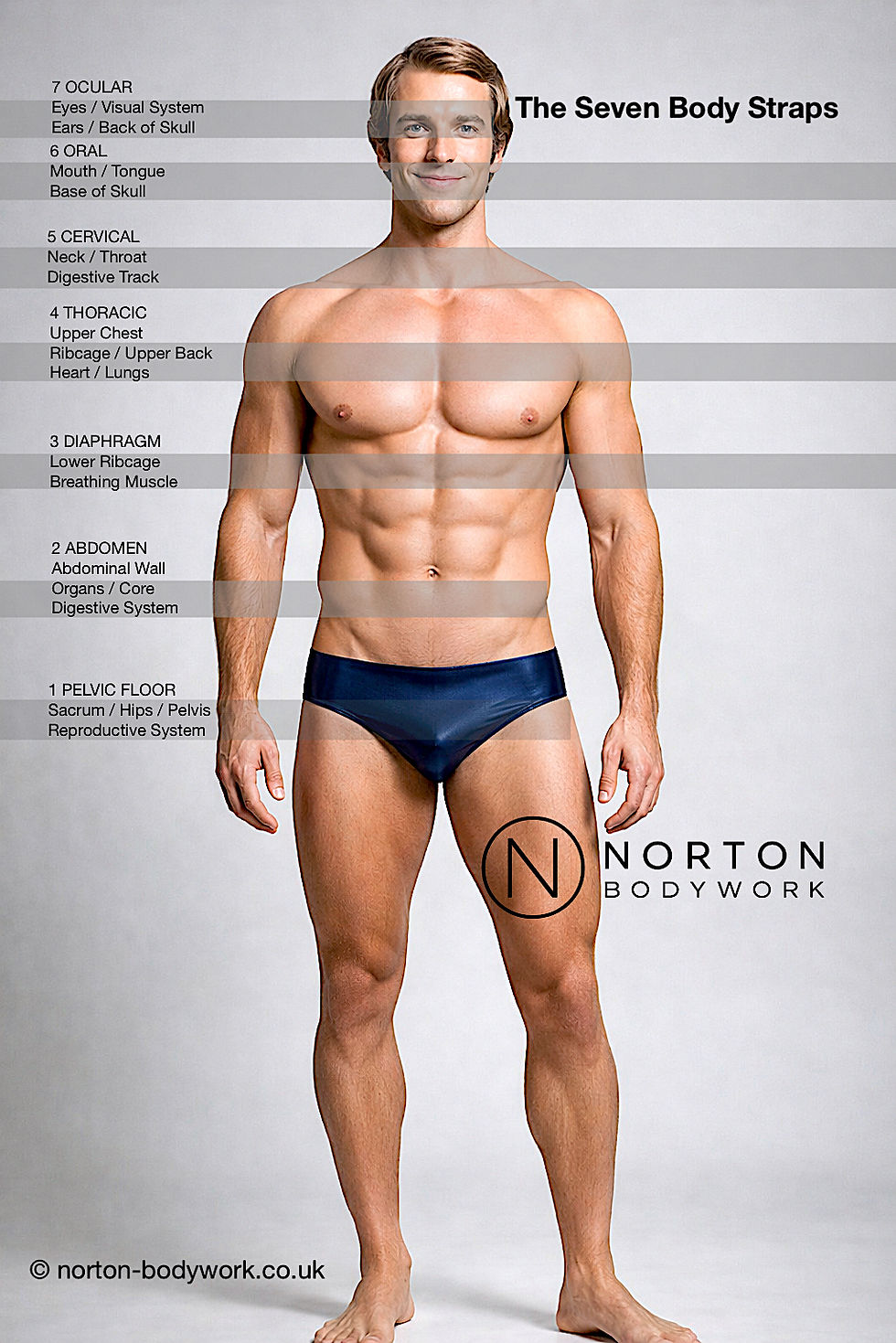
3. The Abdomen and 2. Diaphragm Straps: The Place Where We Hold More Than We Realise.
Let's continue with the second and third body straps that sit in the middle of the body.
The abdominal and diaphragm straps, these two straps are closely related.
-The abdominal strap includes the large abdominal muscles, the rectus abdominis, the transverse abdominis, the obliques, the muscles of the lower back, the psoas and the flanks. Together they form a powerful support system around the organs and the spine.
-The diaphragm strap sits directly above it. Running beneath the ribcage and lower end of the sternum, the diaphragm separates the body into upper and lower regions.
Above the diaphragm we find the eyes, ears, nose, mouth, arms and brain.
The structures we use to reach into the world, communicate, take in - defend ourselves, work, create and interact with our environment.
Below the diaphragm we find the stomach, liver, gallbladder, pancreas, kidneys, intestines, pelvis and the organs responsible for digestion, elimination, storage and processing.
One part gathers experience.
The other part processes it.
The diaphragm sits between the two zones.
Mechanically, it is the body's primary breathing muscle and one of its most important pressure regulators. Every breath changes pressure above and below this boundary. And here You are; reading this article provably in the modern workplace, as you can see in the image bellow, a particularly brutal place on these two body straps.

The body adapts to the position it spends the most time in and what starts as posture eventually becomes habit. What becomes habit eventually feels normal. Many people no longer realise they are holding tension through their abdomen all day long.
Then the neck and shoulders begin helping the body do a job that belongs to the diaphragm. The consequences can show up in many different ways: Digestive discomfort. Bloating. Abdominal pain. Shallow breathing. Anxiety. Neck tension. Fatigue. A feeling of never quite inhaling and exhaling a full breath.

Remember the major abdominal organs all live within this region: The stomach. Liver. Gallbladder. Pancreas. Kidneys. Intestines all connected by Vagus Nerve one of the body's most important communication pathways between the brain and the internal organs.
The Vagus Nerve helps: regulate digestion, heart rate, breathing, recovery and many of the processes associated with rest, repair and restoration. When the body feels safe, the vagus nerve supports digestion, healthy organ function and efficient energy use. When the body perceives threat, pressure or prolonged stress, the balance shifts towards the sympathetic nervous system - the body's alarm system.
Breathing becomes shallower.
Heart rate increases.
Muscles tighten.
Digestion slows down.
Resources are redirected towards survival rather than maintenance. This response is incredibly useful during genuine danger.
The problem is that many modern bodies spend hours, days and sometimes years behaving as though danger is constantly present. The body cannot always tell the difference between a charging predator, an impossible deadline, financial pressure, grift, break up or a mind that never switches off.
This is also the region where many people instinctively protect themselves.
Crossed arms across the abdomen or your chest while you talking to your boss? Our senses are constaly scanning the enviroment without our conscious effort.
Sadly our culture rewards constant productivity, constant availability and constant stimulation, so the body goes into:
Brace.
Push.
Hold.
Keep going
=
Trust in the environment Decreases - Vigilance Increases.
Your body listens to your intensions and mental enviroment more carefully than you might think.
Eventually it will let you know its opinion.
The question is not whether structural body compensation is happening or if your system is bracing for impact, adapting to pressure, or suppressing things it cannot currently process. Because that is already a done thing. We all live under external demands and internal stressors.
Every day the mind filters, suppresses and prioritises information so the system can keep functioning. It is not a flaw. It is a survival mechanism.
The keeper is doing his job.
Like a nightclub bouncer standing at the door, deciding what gets in, what stays out, and what is not getting past him tonight. Most of the time he is doing exactly what he was designed to do.
Awareness As The Answer.
The more useful question becomes: Where has all that adaptation landed in my body?
Am I breathing above the diaphragm or below it?
Up in the chest?
In the middle ribs?
Into the stomach?
Into the lower belly?
Is my "six-pack" always switched on?
Too tight?
Too loose?
Bloated?
How does a full belly breath feel?
Easy?
Restricted?
Uncomfortable?
Difficult?
Don't try to change anything. Just notice.
The body is constantly giving us feedback. Trust it.
Before leaving I would like to share with you these 3 simple practices that can help restore function. Practised regularly and gradually, they can make a noticeable difference.
1. Lower Belly Breathing.
Take 5 slow breaths into the lower belly. Let the abdomen expand gently, like inflating a balloon. If this feels difficult, place one hand over the lower belly as a guide and breathe into your hand. No forcing, just slow expansion and release.
2. The Morning Stretch.
Before getting out of bed, reach both arms overhead and lengthen through the entire body. Take a slow breath in and then a long breath out.
Repeat 5 times.
Simple.
Not sexy.
No expensive equipment required. Your ancestors somehow managed this advanced technique without a smartwatch.
3. Open Book Rotation.
Lie on your side with your knees bent and arms stretched out in front of you.
Slowly open the top arm and rotate your chest towards the opposite side as if opening a book. Let your eyes follow the hand.
Take 3 to 5 slow breaths before returning to the starting position.
Repeat on both sides.
This helps restore movement through the ribcage, chest and upper abdomen — areas that often become stiff after years of sitting, driving, typing and arguing with Excel spreadsheets.
You don't need to force any of these exercises. Just notice what moves easily.
Notice what feels restricted. Notice where the body is still holding on.
Awareness often arrives before change.
That's All For Today Folks!
Next time let's talk about Thoracic, Cervical Straps.
And ending with Oral and Occular Straps.
Stay Tune - All The Best.
Sergio Alexander Norton - LMTs, ITEC
General Disclaimer
The contents of this article is intended to provide useful information to the general public. All materials, including texts, graphics, and images, are for informational purposes only and are not a substitute for medical diagnosis, advice, or treatment for specific medical conditions. All readers should seek expert medical care and consult their own GP’s.
This series is informed in part by many, many connective tissue / fascial anatomy works such as of R. Louis Schultz PhD and Rosemary Feitis DO, Bioenergetics works from Wilhem Reich and Elsworth F. Baker, M.D. and anatomy and streching works of Craig Ramsay and by Thomas Myers. Accessinng the Healing Power of the Vagus Nerve, Stanley Rosenberg. The Polivagal Theory - Stephen W. Porgues.
"Seven Body Straps" AI image for editorial purposes copyrigth:norton-bodywork 2026
image "Backcare.co.uk - Anatomy Trains- Thomas Myers."


Comments