
5.The Cervical, 6. The Oral And 7. The Ocular Straps. The Seven Body Straps.
Updated: Jul 13

If you've followed this series from the beginning, congratulations!
We finally reached the last three straps of The Seven Body Straps series.
We've travelled through the body from the ground upwards.
We started with the pelvic strap, the foundation that supports us. We moved into the abdominal strap, where we process, protect and contain. Then came the diaphragm, the body's great pressure regulator, followed by the thoracic strap—the protective cage surrounding the heart and lungs.
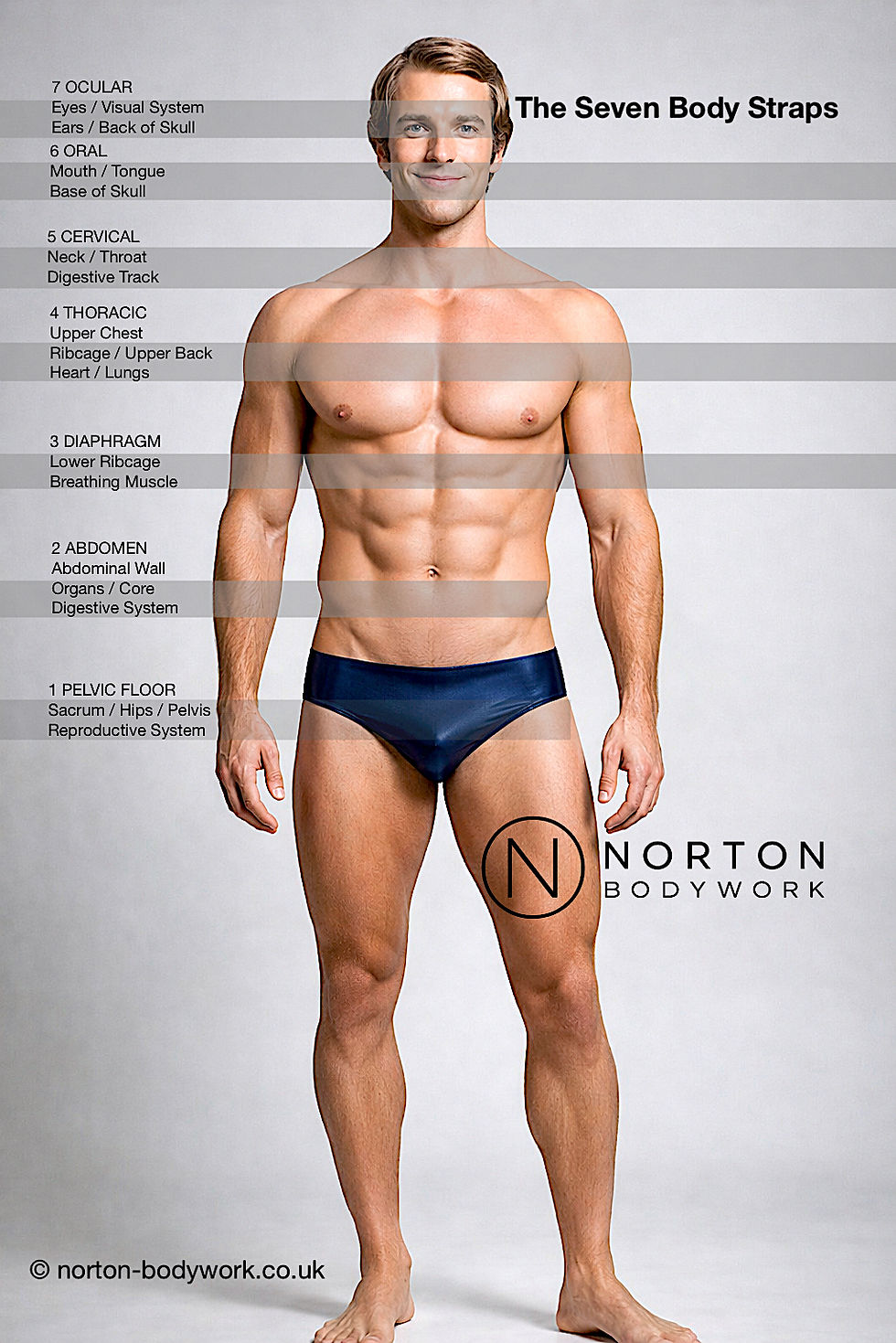
The final three straps—the cervical, oral and ocular—complete that journey.
They are where movement becomes communication, perception and expression.
This is where the body meets the world.
Like every strap we've explored, they don't work alone. Restrict one and the others begin adapting. Free one and you'll often notice change somewhere completely different.
5. The Cervical Strap.
The Weight We Carry.
The cervical strap is often reduced to "the neck." In reality it is far more than that. It continues beneath the collarbones, across the shoulders and into the upper ribs, connecting the head to the rest of the body through muscles, fascia, blood vessels, nerves, the airway and the digestive tract. It is a remarkably busy intersection where structure and function meet.
The neck isn't hanging in space. It's suspended from the shoulders, upper ribs and collarbones. If the thoracic strap loses mobility and the upper ribs stop expanding with the breath, the shoulders begin compensating.
Eventually the neck joins in.
I've always thought the shoulders were the builders of the body. Through them we reach for the world. We pull, push, lift, carry, climb, throw, defend ourselves, hug the people we love and shake another person's hand.

The shoulders are built for movement, not stillness. Then along came modern life.
Now they spend eight or ten hours a day hovering over a keyboard while only the fingers move. It's a bit like playing the piano without the music. The hands keep working but the joints slowly forget what they're designed to do.
Healthy joints are supposed to move.
One joint influences the next.
The phrase "carrying the weight of the world on your shoulders" has survived for generations because most of us recognise it instantly.
Shoulder Rolls.
Stand or sit comfortably with your arms relaxed by your sides.
Slowly roll both shoulders forwards in smooth circles 10 times. Don't force the movement or try to make the biggest circles possible. Just let the joints move naturally.
Stop. Relax your shoulders.
Notice.
Do they feel lighter? Warmer? Stiffer? Looser? Can you feel any tingling, twitches or areas that seem reluctant to let go? Don't judge it - just observe.
Now slowly roll both shoulders backwards 10 times, allowing the shoulder blades to glide gently towards each other before relaxing again.
Stop. Let your shoulders settle naturally.
Take a slow breath and simply notice if anything feels different.
Remember, the goal isn't perfect movement.
The goal is simply to remind your shoulders that they were built to move, not to stay frozen all day.
The "I Don't Care" Shrug.
Here's another one...
No equipment needed.
No gym membership.
No yoga mat.
Just your shoulders mate.
Shrug them up towards your ears like you're doing dumbbell shrugs at the gym—only this time without the dumbbells. Then let them drop.
Again.
Shrug...
...and release.
Now add a little attitude.
"I don't fucking care." attitude.
Shrug!
Release.
"I don't fucking care." say it loudly preferely not in the office and try it in front of a mirror.
Shrug!
Release...
Do it ten times.
Think about when you were a kid for a moment. When a child shrugs their shoulders, they're not worrying about perfect technique. They're saying, "Whatever."
Their whole body joins in. There's movement, expression and playfulness.
Somewhere along the way, most adults men stop doing that.
We become serious. Rigid. Professionally tense.
Don't force the movement or try to shrug as high as possible.
You're not trying to set a new personal best. Just notice.
Do the shoulders feel lighter?
Do they drop a little further afterwards?
Can you feel warmth, tingling or little twitches as the muscles begin letting go?
The point isn't the shrug.
The point is giving yourself permission to move again and prehaps carry less.
The body likes to play. Sometimes giving yourself permission to move with a bit of humour and attitude is enough to interrupt an old holding pattern.
Protection Before Thought.
The cervical strap doesn't stop at the neck. It continues beneath the collarbones and into the axilla (armpit), linking the neck, shoulders and upper ribs into one functional unit.
We explored the anatomy and protective role of the armpit in the Thoracic Strap
article, so I won't repeat it here. The important point is that these structures work together.
6. The Oral Strap
The Words We Swallow.
The oral strap includes the lips, jaw, tongue, floor of the mouth and the muscles surrounding them. It is one of the busiest regions of the human body. Every day it allows us to eat, breathe, smell, speak, laugh, chew, swallow, yawn, kiss and communicate with the people around us.
It is also one of the places where modern life quietly stores tension thorugh concious - don't shout to your boss the F word if you dont have plan B and uncouncious patterns of repression.
Jaw clenching has become almost fashionable. Many people grind their teeth during sleep without ever knowing it. Others carry constant tension through the tongue or keep the jaw lightly clenched all day while concentrating at work.
The fascinating thing is that the jaw rarely works alone. It lives in constant conversation with the neck, the throat and, surprisingly often, the pelvis.
Clinically, it isn't unusual to notice changes in jaw movement alongside changes in the hips or pelvis. Improving hip mobility sometimes softens the jaw. Releasing jaw tension occasionally changes the way somebody walks. I'm not suggesting one directly causes the other. I'm simply pointing out that the body distributes forces through long fascial chains rather than storing them in neat anatomical compartments.
The body doesn't read anatomy books! It simply adapts. Stress also changes the way we speak. We've all experienced it.
You're angry and your voice tightens.
You're nervous and your mouth goes dry.
You're grieving and suddenly there's a lump in your throat.
Emotions have a physical address.
Sometimes the words we never said become muscles we never relaxed.
Fortunately, there are simple ways of helping the oral strap let go.
One of my favourites is humming.
It sounds almost too gay and simple to work, but humming creates gentle vibrations through the lips, tongue, soft palate, pharynx and larynx while encouraging slower, quieter breathing.
Many people notice that the jaw softens, the throat opens and breathing becomes easier after only a minute or two. It’s a simple exercise, but don’t underestimate it.
Another technique is working with the gag reflex. This requires a little more care and shouldn’t be rushed, so I’ll cover it properly in a future article. When approached correctly, it can help reduce excessive tension around the tongue, throat and deeper muscles of the oral strap.
I also use tongue mobilisation or what I simply call tongue pulling. Gentle traction through the tongue can help release tension in the floor of the mouth and the tissues attaching the tongue deeper into the throat. Through its fascial relationships, the tongue is connected to the hyoid bone, jaw, neck and base of the skull. It’s remarkable how often releasing the tongue changes the way the neck moves or the quality of someone’s breathing.
If you haven't already, I'd encourage you to read my previous article link below.
7. The Ocular Strap.
The World We See.
Smell.
Hear.
The final strap surrounds the eyes, temples, ears, scalp and the back of the skull.

This is our orientation system.
Long before the conscious mind has decided whether a situation feels safe or threatening, the eyes have already begun gathering information. Healthy eyes are constantly adapting.
They look near and far, scan left and right, track movement and continuously orient us within the world around us. Like every other joint and muscle in the body, they thrive on variety. Modern life doesn't give them much.
Sure - You could argue with that. After all, we spend hours looking at computers, phones and tablets. Surely that's visual activity?
Perhaps.
But staring at a screen isn't variety.
It's CONDITIONING.
The eyes become remarkably good at doing one thing, at one distance, in one direction, for hours at a time. They stop exploring and start repeating.
We'll talk much more about conditioning in a future blogs.
For now, let's get back to the eyes.
Most of us spend hours looking at a screen less than an arm's length away. Over time the muscles around the eyes become less adaptable, the forehead tightens, facial expression reduces and pressure begins building through the temples or behind the eyes.
The scalp is often forgotten. The scalp isn't simply where your hair grows or falls. It is living connective tissue, continuous with the fascial system that begins beneath your feet, travels through the calves, hamstrings, sacrum, spine and neck, before reaching the scalp. From head to toe, it's one continuous conversation.

Gentle scalp mobilisation can produce surprisingly noticeable changes through the jaw, temples and neck.
Bombarded From the Outside In.
The ocular strap has a difficult job. Unlike the pelvis or the ribcage, it never really gets a break. Our eyes, ears, nose and mouth sit within a few inches of each other.
Together they form the body's main communication centre with the outside world.
Every second they're gathering information.
Light.
Sound.
Smell.
Movement.
Temperature.
Facial expressions.
The nervous system is constantly sorting through all of it, deciding what matters and what can safely be ignored. Modern life asks even more. Bright screens. Artificial light.
Traffic. Headphones. Notifications. Conversations. Poker Faces. You name it.
I'll explore the idea of conditioning in another article as I said. For now, it's enough to appreciate that this region rarely gets the opportunity to switch off.
When the nervous system remains on high alert, this strap often reflects it.
Give The System A Break.
Fortunately, the ocular strap also responds well to gentle movement.
One simple exercise is to lightly tap around the bony edge of each eye socket using your fingertips. Work slowly around the orbit, completing two or three gentle circles before moving on to the temples and the base of the skull.
Another simple practice is to soften your gaze.
Instead of staring directly at one point, allow your peripheral vision to widen. Notice what you can see at the edges of your visual field without moving your head.
Healthy eyes were designed to explore. If you spend long hours in front of a screen, this small exercise - follow the ball - can feel surprisingly challenging and refreshing.
Even the ears contribute to the story. Small branches of the vagus nerve (see previous Straps blog entry) reach this area, linking hearing and sensory information with the autonomic nervous system.
Spoiler alert!
If you've ever wondered why I spend so much time working around your ears— particularly the left one — now you know. I promise I haven't lost my way. There's method behind the madness. Once again, the body reminds us that nothing functions in complete isolation.
... Gravity Takes It All.
The body develops from the ground upwards. We begin life rolling, crawling and pushing ourselves against gravity before we eventually stand. Every stage of development teaches the body to organise itself a little better against one constant force that never takes a day off.
Gravity.
One idea fascinated me throughout my fascial studies is experiencing the power of gravity.
Most of us barely notice it, yet every second of every day our body is negotiating with it.
Bones, muscles, fascia, joints and the nervous system are constantly adjusting so we can remain balanced, upright and free to move. That conversation never ends.
Restriction in the pelvis changes the spine.
Restriction in the ribcage changes the neck.
Restriction around the jaw changes the face.
Pressure is redistributed.
Compensation begins.
The body keeps adapting because that's what bodies do.
Perhaps that's why I often ask clients to lie quietly on the floor for a few minutes. Not to "do" anything. Just to experience gravity. To feel their own weight surrendering to the ground, allowing the body to stop negotiating for a moment and simply be supported.
Sometimes gravity becomes one of the greatest teachers we have.
It asks for nothing. It judges nothing.
It simply reveals how your body has organised itself over a lifetime.
If you're willing to pay attention, gravity tells no lies.
Try something.
Lie on the floor.
No pillow.
No phone.
Simply let gravity do the work.
Allow your body to become heavy.
Notice where you make contact with the floor and where you don't.
Feel your breathing without trying to change it.
Stay there for as long as feels comfortable.
Then slowly stand up.
Don't rush.
Don't criticise yourself.
Just notice.
Has anything changed in the body?
Has anything changed in the body?
Just notice.
Sometimes awareness is far more powerful than another stretch.
Final Thoughts.
I hope you've found this series helpful.
More than anything, I hope it's encouraged you to approach your body — and perhaps yourself — with a little more awareness, understanding and compassion.
Throughout this series I've been talking about the average body responding to everyday life, not people living with specific medical conditions or those born with physical or neurological challenges. Every body has its own story.
The body is constantly adapting to the life we ask it to live.
It isn't trying to work against us.
Quite the opposite.
It's doing its best to protect us with the tools it has available at the time.
The body isn't to blame.
The more we understand those adaptations, the easier it becomes to stop fighting our body and start working alongside it. Information is power. And with knowledge comes choice. Choice allows us to move, breathe and express ourselves a little more truthfully.
Thank you for your time spent reading this series - it means a lot to me.
Writing this series has also been an exercise for me. It has given me the opportunity to share some of what I've learnt over many years studying body-based psychotherapy, fascial anatomy and through thousands of hours working with people on the treatment room.
As always, take what is useful, stay curious, and keep listening to what your body has been trying to tell you all along.
Here to help,
Sergio Alexander Norton
LMTs • ITEC
General Disclaimer
The contents of this article is intended to provide useful information to the general public. All materials, including texts, graphics, and images, are for informational purposes only and are not a substitute for medical diagnosis, advice, or treatment for specific medical conditions. All readers should seek expert medical care and consult their own GP’s.
This series is informed in part by many, many connective tissue / fascial anatomy works such as of R. Louis Schultz PhD and Rosemary Feitis DO (1), Bioenergetics works from W Reich and Elsworth F. Baker, M.D. "Seven Body Straps" and All images for editorial purposes copyrigth norton-bodywork 2026 - (Fascia - connective tissue - system from toes to head. Reproduction with kind permission from Anatomy Trains: Thomas W. Myers)

Comments