
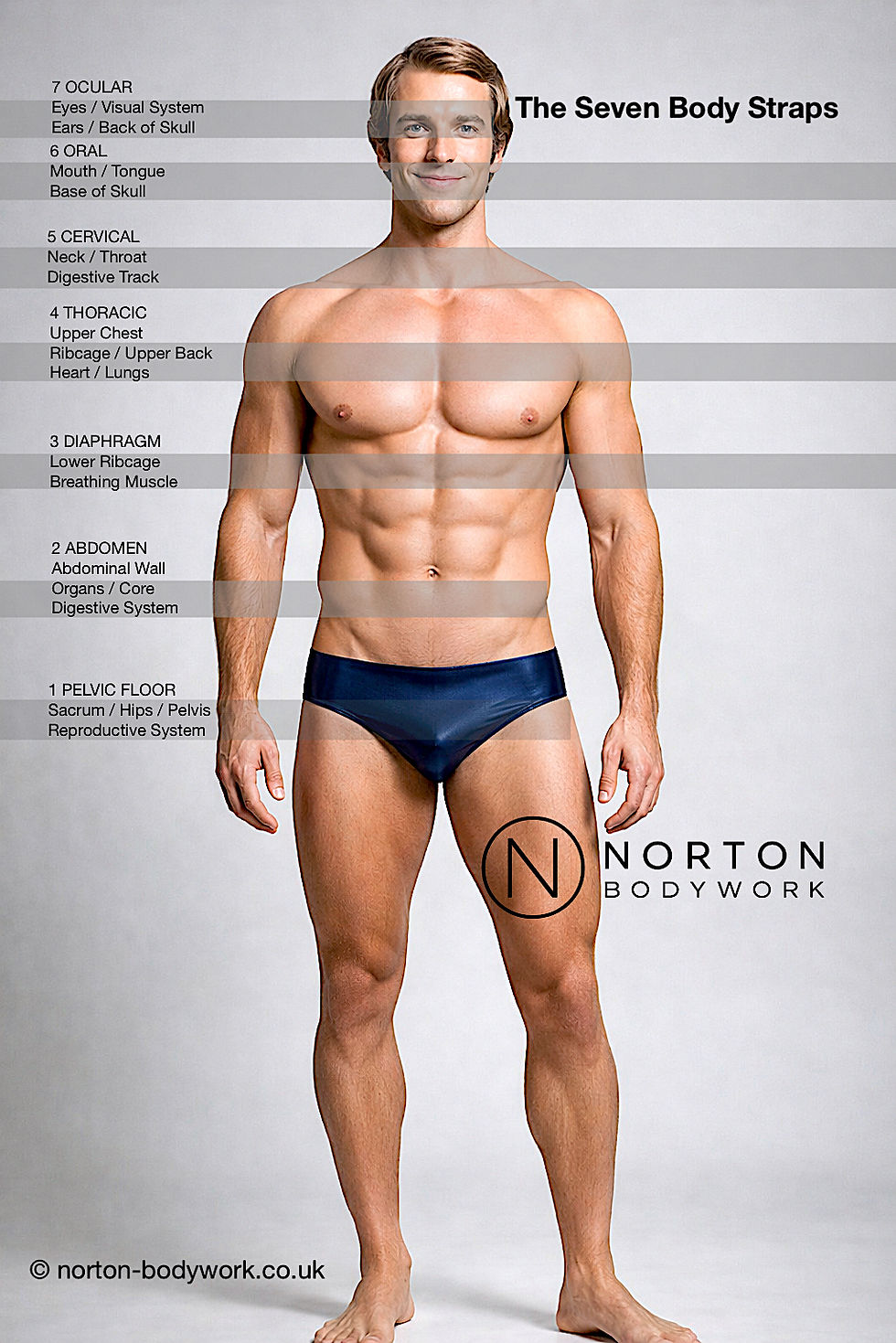
4. The Thoracic Strap - The Protective Cage. The Seven Body Straps Series.
Updated: Jul 11

Let’s keep moving up. So far, we’ve travelled from the ground upwards.
We started with the pelvic strap — the body’s foundation. Then we explored the abdominal strap — where we process, support, and protect. Next, we examined the diaphragm strap — the great pressure regulator separating the upper and lower halves of the body. Now, we arrive at the thoracic strap.
This is where the body begins to open towards the world. The ribcage, heart, lungs, shoulders, and upper back all meet here. It is a region built for movement, expansion, and protection, constantly adapting with every breath we take.
The thoracic strap surrounds the heart, lungs, ribcage, upper chest, and upper back. It is both powerful and vulnerable. This region protects some of the most vital organs in the body while remaining flexible enough to expand and contract with every breath.
The ribcage was never designed to be rigid. It was designed to move thousands of times every day. Every breath changes its shape. Every movement asks it to adapt. Yet many modern bodies spend long hours collapsed over desks, steering wheels, and phones.
As a result, the chest narrows, the shoulders roll forward, and the upper back stiffens. Breathing gradually becomes smaller. The lungs lose space, and the ribcage loses mobility.
This is also the area many people instinctively shield, and that’s why we need to talk about the armpits. The axilla (armpit) contains major structures passing between the neck, chest, and arm:
The axillary artery
The axillary vein
The brachial plexus (major nerves)
Lymphatic vessels and nodes
It is a relatively unprotected soft-tissue region compared with the ribcage itself. That’s one reason why many martial arts, military, and self-defence systems historically recognise the armpit as a vulnerable target area.

Interestingly, most people are also extremely ticklish in this area.
We usually think of ticklishness as something amusing, but from a biological perspective, it may also serve a protective purpose. Sensitive areas of the body often provoke an immediate reaction. We pull away, close down, guard the area, or move to protect it.
Watch what happens when someone unexpectedly reaches towards your armpit. They react. The shoulders narrow. The arms come in. The chest closes. Instinctively, you want to protect yourself… or punch back. Sometimes the body moves to protect itself before the mind has even caught up.
Crossed arms, rounded shoulders, and a chest that folds inward are common signs this area has become guarded. It’s one of the body’s oldest protective strategies. Over time, restricted movement through the thoracic strap can leave you feeling physically compressed. Almost like wearing a straitjacket. On a deep emotional level, sometimes there can also be a subtle feeling of not being enough, not having enough, or not quite being able to expand fully into life.
"In order to feel alive and comfortable, we need free flow." Whether we call it the free flow of movement, pressure, breath, energy, or communication between different parts of the body, the principle remains the same.
Life depends on movement.
Health depends on adaptability.
Above the thoracic strap are the eyes, ears, mouth, nose, arms, and brain — the parts of us that reach outward into the world. Below it are the diaphragm, abdomen, pelvis, and digestive organs — the parts responsible for support, processing, elimination, and regulation.
When movement becomes restricted through the chest and ribcage, the conversation between these regions becomes less efficient.
When movement returns to the thoracic strap, the body feels less like a collection of separate parts and more like a connected system again.
Three Simple Ways to Restore Mobility.
1. Chest Expansion Stretch
Stand tall and clasp your hands behind your back. Gently straighten your arms and allow the chest to open. Lift the breastbone slightly without forcing the lower back. Hold for 20–30 seconds while breathing slowly.
You are not auditioning for a military parade. Just give the ribcage permission to remember it can expand.
2. Direct Your Breath Into The Chest
Place both hands on the sides of your ribcage. Take five slow breaths and deliberately expand the ribs into your hands. Feel the chest widening sideways rather than lifting the shoulders upward.
Many people have not felt their ribcage move properly in years. The first time can be surprisingly revealing.
3. Supported Thoracic Twist
Begin in a child position - kneeling with the hips sitting back towards the heels. Place one arm behind the head and slowly rotate the chest towards the wall.

Notice the difference between the two sides.

In my case, my left side does not allow me to rest my hips fully back towards my heels. That’s okay. I have a shorter leg and a slightly wonky side. The goal here is not perfection or symmetry worthy of an anatomy textbook.
The goal is awareness.
One side may move more freely than the other. One shoulder may rotate further. One side of the ribcage may expand more easily. That is useful information.
Do not force the movement. Do not fight your body.
Work with the range you have today rather than the range you think you should have. Respect the restriction.
Breathe into it. Observe it.
Remember, mobility is not a competition, and nobody is handing out medals for forcing yourself into positions your body is not ready for.
Take 3–5 slow breaths at the end of the movement before returning to the starting position. This exercise will help you restore mobility through the thoracic strap while helping the cervical strap stop doing work that belongs to the upper back.
You might think your neck is the problem, but quite often, the trouble starts a couple of inches lower.
Ok, guys, that is it.
We still have the cervical strap, the oral strap, and the ocular strap to explore and is going to be a bit longer to read 9/10 minutes. Until then, I hope this has helped you become a little more aware of your body, your posture, and the subtle ways it adapts to life around you.
All The Best.
Sergio Alexander Norton - LMTs, ITEC
General Disclaimer
The contents of this article are intended to provide useful information to the general public. All materials, including texts, graphics, and images, are for informational purposes only and are not a substitute for medical diagnosis, advice, or treatment for specific medical conditions. All readers should seek expert medical care and consult their own GP’s.
This series is informed in part by many, many connective tissue/fascial anatomy works such as those of R. Louis Schultz PhD and Rosemary Feitis DO, Bioenergetics works from Wilhelm Reich and Elsworth F. Baker, M.D. Seven Body Straps" image for editorial purposes copyright: norton-bodywork 2026 - "protect what matters most: the thoracic box" instagram @ctomsinc

Comments